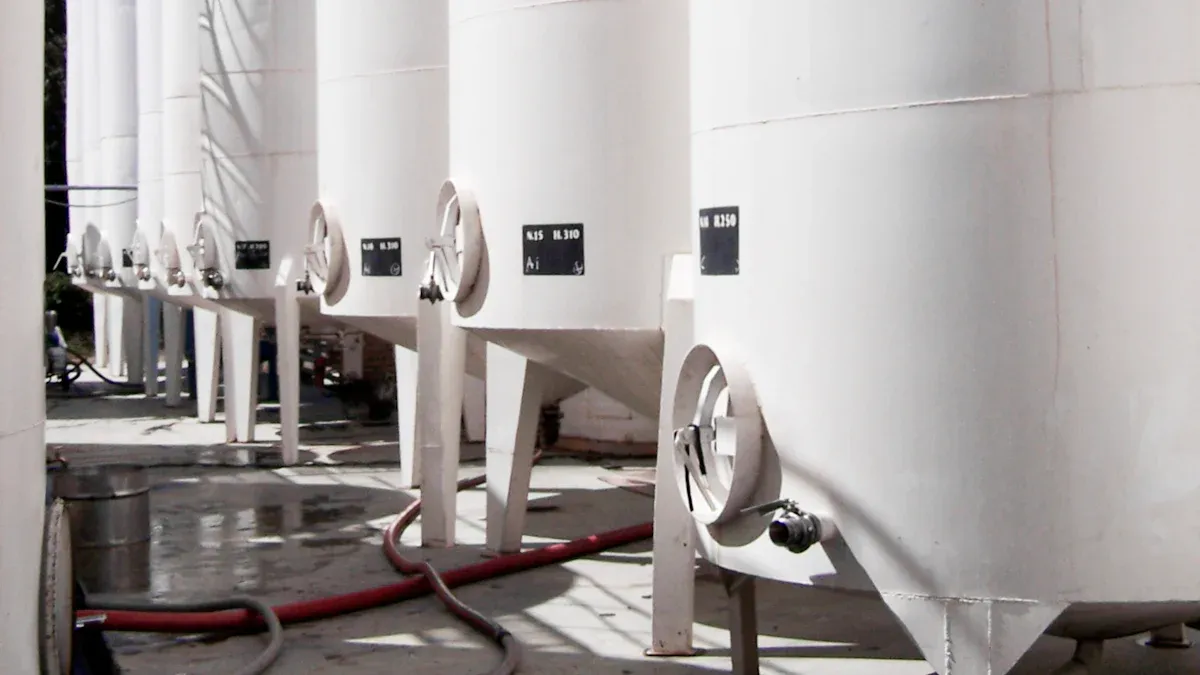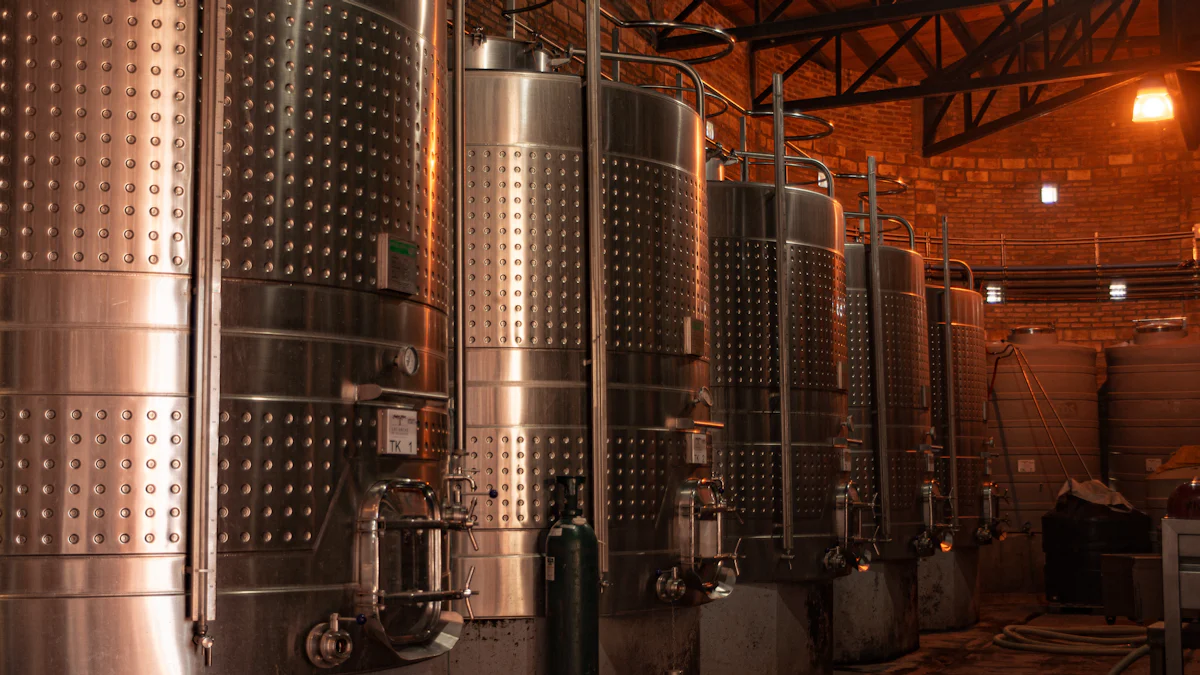

On average, forced carbonation with a carb stone takes 30 minutes to 6 hours (almost always under 24 hours) to reach target CO₂ levels in a bright tank. Natural carbonation driven by residual yeast is much slower, requiring 1–3 weeks to complete. In total, beer typically stays in a brite tank for 1–5 days, depending on beer style, clarity goals, and carbonation method.
Key Takeaways
- Forced carbonation via carb stone takes 30 minutes to 6 hours, and nearly always finishes within 24 hours.
- Natural carbonation with residual yeast takes 1–3 weeks, with timing dependent on yeast health and temperature.
- Colder beer absorbs CO₂ faster — hold temperatures near 0°C (32°F) for the fastest and most stable results.
- Maintain tank head pressure slightly below carb stone pressure to drive efficient gas dissolution.
Typical Carbonation Timing in a Bright Tank

A bright (brite) tank is the final conditioning vessel before packaging, used for clarification, cold conditioning, and carbonation all in one vessel. Total turnaround time depends almost entirely on which carbonation method you use.
Forced Carbonation (Carb Stone Method)
This is the standard for commercial production. CO₂ is injected through a porous carbonation stone at the bottom of the tank, creating tiny bubbles that dissolve into the beer.
- Fastest cases: 30 minutes to reach 2.5–3.0 volumes of CO₂ for small batches or low targets
- Standard production batches: 5–6 hours for full, stable carbonation
- Safe upper limit: nearly all batches reach target within 24 hours
The process is highly predictable and tightly controllable, making it ideal for tight production schedules.
Natural Carbonation
Also called conditioning carbonation, this method relies on residual yeast consuming priming sugar to produce CO₂ naturally inside the tank.
- Typical range: 1–3 weeks to reach target carbonation
- Speed varies based on yeast health, holding temperature, and sugar dosage
- Best for traditional cask ales, bottle-conditioned styles, and beers where a softer, more integrated carbonation profile is desired
Total Bright Tank Residence Time
For forced carbonation batches, beer stays in the bright tank for 1–5 days total, including carbonation plus any cold conditioning or clarification time. Styles requiring extra clarity or flavor maturation can extend to 2–5 days or longer. There is no fixed universal timeline — brewers package once the beer meets all carbonation, clarity, and flavor targets.
Forced vs. Natural Carbonation
| Factor | Forced Carbonation | Natural Carbonation |
|---|---|---|
| Core mechanism | CO₂ injected via porous carb stone | Residual yeast ferments priming sugar to produce CO₂ |
| Time to target | 30 min – 24 hours | 1 – 3 weeks |
| Control precision | Very high; exact CO₂ volumes are easy to dial in | Less predictable; depends on yeast activity |
| Best use case | Commercial production, fast turnaround, consistent batches | Traditional styles, cask ale, bottle conditioning |
| Required equipment | CO₂ supply, regulator, fine-pore carb stone | Priming sugar, healthy viable yeast |
Key Factors That Affect Carbonation Speed

Temperature and pressure are the two biggest drivers of carbonation rate, but several other variables change timing batch to batch.
1. Beer Temperature
CO₂ dissolves far more readily in cold liquid. Colder beer absorbs gas faster and holds it more stably.
- Optimal temperature: as close to 0°C (32°F) as your system allows
- Warmer beer gives CO₂ molecules more energy to escape, slowing dissolution and increasing foaming risk
- Stable temperature prevents inconsistent results; always confirm temperature stability before packaging
2. Pressure Differential
The pressure gap between the carb stone and tank headspace is what drives CO₂ into solution.
- Core rule: keep tank head pressure slightly lower than carb stone pressure to push gas into the beer instead of trapping it at the surface
- Common baseline (sea level, 32°F, 2.7 vol CO₂): ~10.5 psig head pressure, ~20.5 psig stone pressure
- Altitude adjustment: add roughly 1 psig of head pressure per 2,000 ft of elevation gain
3. Carb Stone Pore Size
Smaller bubbles create far more total surface area for gas to dissolve. A 0.5–2 micron stone dissolves CO₂ much faster than larger sparging stones or headspace purging. Clogged or fouled stones will slow carbonation dramatically and should be cleaned between batches.
4. Batch Volume & Beer Style
Larger batches take longer to fully carbonate. Higher-gravity beers, high-protein beers, and styles with different target CO₂ levels will also have slightly different timelines.
How to Speed Up Carbonation Consistently
Follow this routine from a bright tank manufacturer for fast, repeatable results batch after batch.
- Chill first: Bring beer down to target temperature (near 32°F) before starting carbonation.
- Set the pressure differential correctly: Run carb stone pressure 8–12 psig above tank head pressure. A standard starting point at sea level is 20.5 psig stone / 10.5 psig head.
- Use and maintain a fine-pore stone: 0.5–2 micron stones deliver the fastest dissolution. Inspect and clean stones regularly to prevent clogging.
- Ramp pressure in stages: Increase CO₂ in small increments rather than all at once to reduce overcarbonation risk.
FAQ
How do brewers choose between forced and natural carbonation?
It comes down to timeline and beer style. Forced carbonation is standard for fast-paced commercial production, finishing in under 24 hours. Natural carbonation is used for traditional cask ales and bottle-conditioned beers, even though it takes 1–3 weeks. Both work well in modern bright tanks.
What do you do if beer becomes overcarbonated?
Vent the tank headspace to release excess CO₂, then hold at the correct pressure for the beer temperature to re-equilibrate. You can prevent most overshoots by ramping pressure up in small steps and keeping head pressure below stone pressure.
Does colder beer always carbonate faster?
Yes. CO₂ is much more soluble in cold liquid, so chilling beer to near 32°F speeds up absorption significantly. A fine-pore carb stone adds another major speed boost. Temperature swings will disrupt results, so always confirm stability before packaging.
How do you know when carbonation is complete?
Tank pressure alone does not confirm dissolved CO₂. You need to measure with a calibrated CO₂ meter such as a Zahm & Nagel unit. Once the target is reached, a 12–24 hour rest period lets carbonation stabilize fully before packaging.
How long does beer stay in a bright tank total?
Most forced-carbonated batches stay 1–5 days total, including carbonation plus any cold conditioning or clarification time. Beers requiring extra clarity or conditioning can stay longer. Natural carbonation requires 1–3 weeks of tank time.