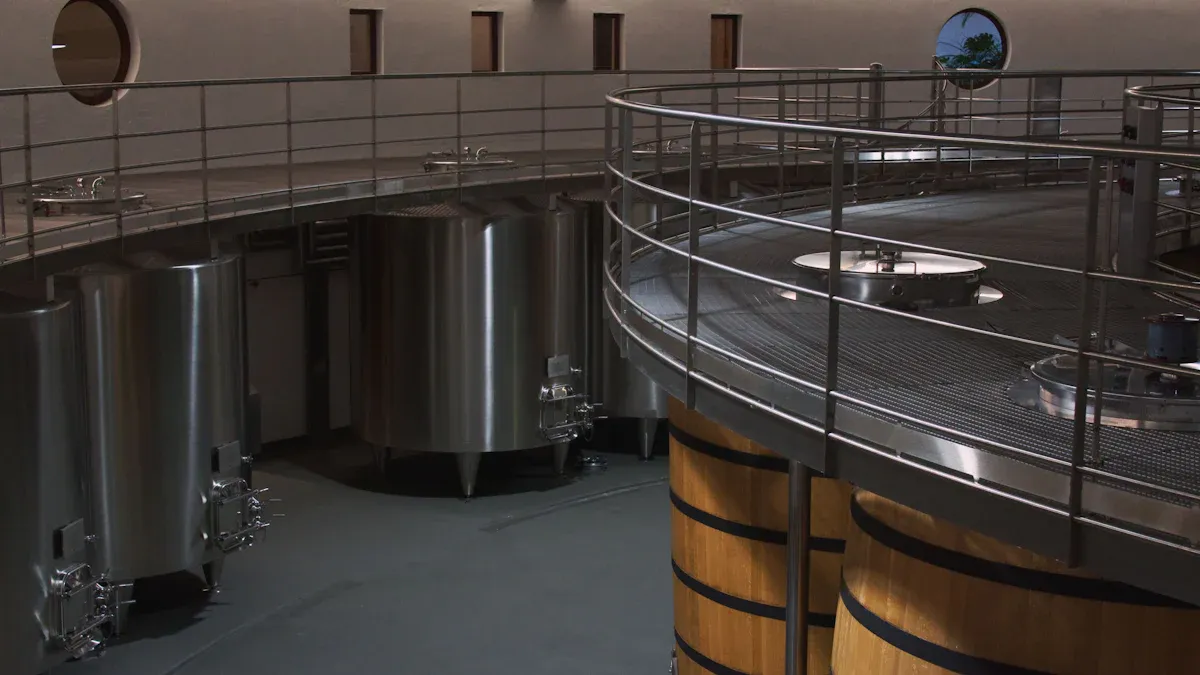

The core difference between vertical and horizontal storage tanks lies in their installation orientation, which creates distinct tradeoffs in space usage, structural design, installation cost, maintenance difficulty and applicable scenarios. Vertical tanks stand upright to minimize floor footprint, making them ideal for sites with limited land area. Horizontal tanks lie on their side with a low center of gravity, fitting well in height-restricted spaces and offering better transportability. Both designs are widely used across industrial, agricultural and commercial sectors. CHENMA manufactures high-quality stainless steel storage tanks in both vertical and horizontal configurations, with fully customizable sizing to match specific project requirements.
Key Takeaways
- Vertical storage tanks maximize storage capacity while minimizing floor space, making them ideal for facilities with limited land and large-volume storage requirements.
- Horizontal storage tanks offer easier transportation, ground-level maintenance, and better suitability for low-height buildings, underground installations, and mobile applications.
- The main differences between vertical and horizontal tanks include footprint, installation requirements, maintenance accessibility, discharge methods, and overall cost structure.
- Total project cost depends on more than the tank price—foundation, transportation, installation, and available site space all influence the most economical choice.
- Choose the tank orientation based on your application, available space, local regulations, and operational needs rather than capacity alone to achieve the best long-term performance.
Vertical vs. Horizontal Storage Tanks: Key Differences
Structural Design
Vertical tanks stand on a flat or conical base. Internal hydrostatic pressure increases with liquid depth, so wall thickness is engineered to be thicker at the bottom and thinner toward the top. The design naturally supports large single-tank volumes.
Horizontal tanks rest on saddle supports. In addition to internal fluid pressure, the tank body must withstand concentrated stress at support points, requiring targeted structural reinforcement. Single-tank volume is typically limited compared to very large vertical units.
Space Efficiency
| Tank Type | Footprint | Height Requirement | Best Site Fit |
|---|---|---|---|
| Vertical | Small — uses height to maximize volume | High | Dense industrial sites, urban facilities, offshore platforms |
| Horizontal | Large — requires wider ground area | Low | Low-ceiling buildings, underground installation, height-restricted zones |
Installation & Transportation
- Vertical tanks: Require a reinforced concrete foundation. Tall units need cranes for on-site lifting. Large-diameter vertical tanks may require oversize transport permits.
- Horizontal tanks: Mount on prefabricated steel saddles. Their low profile fits standard flatbed trailers, making transport simpler and cheaper. Installation is faster, especially for skid-mounted and modular systems.
Cost Profile
| Cost Factor | Vertical Tanks | Horizontal Tanks |
|---|---|---|
| Material cost | Lower for equivalent volume | Higher due to saddle reinforcement and thicker stress points |
| Foundation cost | Lower — simple concrete pad | Higher — requires engineered saddle supports |
| Land cost | Lower — small footprint | Higher — wider ground area needed |
| Transport cost | Higher for large units | Lower — fits standard logistics |
Maintenance & Operation
- Cleaning & sediment management: Vertical tanks concentrate sediment at the bottom center, making drain-down flushing and sludge removal simpler and more thorough.
- Personnel access: Horizontal tanks typically have side manways at ground level, so technicians can enter without ladders or scaffolding, reducing safety risks during inspection.
- Fluid discharge: Vertical tanks leverage hydrostatic head pressure for gravity-fed discharge, reducing pump energy costs. Horizontal tanks almost always require active pumping for full emptying.
Stability & Safety
Horizontal tanks have a lower center of gravity, giving them better resistance to wind, seismic activity and tipping. Vertical tanks are inherently stable when properly anchored, but require a robust foundation to handle overturning forces from wind and seismic loads.
Both tank types must comply with applicable industry standards for the stored liquid, including UL-142 for flammable fuels, EPA SPCC rules for oil storage and NFPA fire safety codes.
Advantages and Disadvantages of Each Storage Tank Type
Vertical Storage Tanks

Advantages
- Minimal floor footprint, maximizes storage capacity per square meter
- Gravity discharge reduces long-term pumping energy costs
- Concentrated sediment simplifies routine cleaning
- Scalable to very large volumes for bulk storage
- Lower total material and foundation cost for equivalent capacity
Disadvantages
- Require sufficient vertical clearance and overhead space
- Tall units need crane access for installation and top-side maintenance
- Higher center of gravity requires stronger foundation design
Best applications: Bulk chemical storage, water treatment plants, food and beverage production, pharmaceutical manufacturing and any facility where land area is limited or expensive.
Horizontal Storage Tanks

Advantages
- Low profile fits under low ceilings and in underground installations
- Lower center of gravity for better seismic and wind stability
- Easier and cheaper to transport and install
- Ground-level manways simplify personnel entry and inspection
- Well suited for mobile and skid-mounted systems
Disadvantages
- Require much more floor space for the same volume
- No natural gravity head pressure; full discharge requires pumping
- Sediment spreads across the full bottom length, making thorough cleaning more labor-intensive
- Higher material and support structure costs
Best applications: Fuel stations, agricultural fertilizer storage, mobile trailer setups, underground storage, low-headroom industrial buildings and modular process skids.
How to Choose the Right Storage Tank Orientation
Follow this decision framework to select the best option:
- Prioritize vertical if: Site space is limited, you need large single-tank volume, or you want gravity-fed discharge to reduce energy costs.
- Prioritize horizontal if: You have strict height limits, need transportable or modular storage, or require ground-level access for frequent inspection.
- Always verify: Local building codes, fire safety regulations and compatibility with your stored liquid type and temperature.
Conclusion
Vertical and horizontal storage tanks each have distinct strengths: vertical tanks deliver the best space efficiency and lowest cost for bulk static storage, while horizontal tanks excel in height-restricted sites, mobile applications and scenarios requiring easy ground-level maintenance. The right choice depends entirely on your site layout, volume needs and operational workflow.
CHENMA’s custom storage tanks are available in both vertical and horizontal configurations, engineered for long service life, reliable sealing and compliance with industry standards. Custom sizing and fitting options ensure a perfect fit for food processing, chemical, water treatment and fuel storage applications.
FAQ
What materials are stainless steel storage tanks made from?
Most stainless steel storage tanks are made from 304 or 316L stainless steel. Grade 304 suits general applications, while 316L offers better corrosion resistance for chemicals and pharmaceutical products.
Can vertical and horizontal tanks store the same liquids?
Yes. Both tank types can store water, food products, chemicals, and oils when built with the appropriate material and specifications. The choice mainly depends on installation space and operating needs.
Which is more cost-effective: a vertical or horizontal storage tank?
It depends on the application. Vertical tanks usually save floor space and material costs, while horizontal tanks are often easier and less expensive to transport and install.
How do you clean a stainless steel storage tank?
Stainless steel tanks can be cleaned with water, suitable cleaning agents, or CIP systems. Regular cleaning helps maintain hygiene and extends the tank’s service life.
How do I choose between a vertical and a horizontal storage tank?
Choose a vertical tank for limited space and large storage capacity. Choose a horizontal tank for low-height installations, easier transportation, or frequent maintenance access.