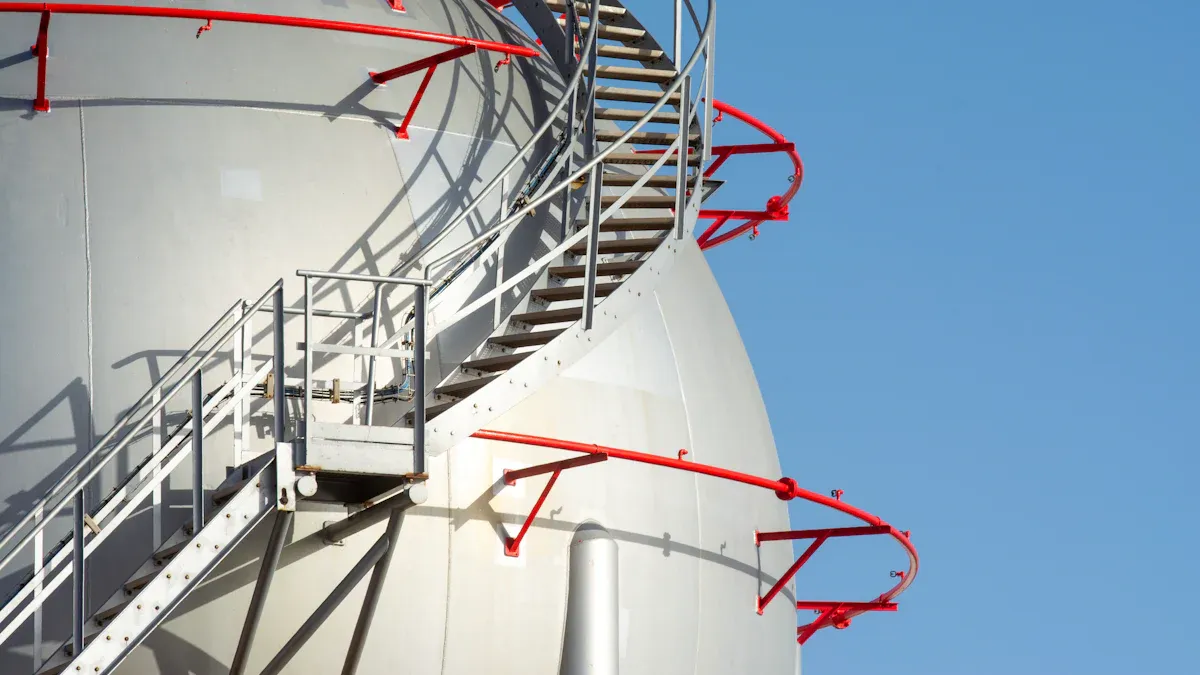

For a standard 5000 litre vertical cylindrical water tank, the tank itself occupies a footprint of roughly 2 meters by 2 meters. When accounting for a reinforced concrete base and required maintenance clearance, you should plan for a total installation area of approximately 4 meters by 4 meters. Exact space requirements vary by tank shape, orientation and installation location: vertical tanks minimize floor footprint, while horizontal tanks fit low-ceiling spaces like basements and rooftops at the cost of wider ground area.
Key Takeaways
- A 5000L vertical cylindrical tank has a ~2m × 2m body footprint; add 200–300mm to all sides for the supporting base.
- Leave 1–2 meters of clear space around all sides of the tank for safe inspection, cleaning and valve maintenance.
- Use a minimum 150mm (6 inch) thick reinforced concrete slab to support the ~5 tonne full weight of the tank.
- Always verify local building codes, setback rules and fire safety requirements before finalizing placement.
- Rooftop installation requires structural engineering approval to confirm the building can support the full loaded weight.
Standard 5000 Litre Tank Dimensions by Shape
Exact dimensions vary by manufacturer and tank design. Below are the most common configurations for 5000 litre storage tanks:
| Tank Type | Typical Dimensions | Body Footprint | Total Height | Best For |
|---|---|---|---|---|
| Vertical Cylindrical | 1.8–2.1m diameter, 1.7–2.2m height | ~2m × 2m | 1.7–2.2m | General ground storage, small footprints |
| Rectangular | ~2.5m × 1.6m × 1.3m | ~2.5m × 1.6m | 1.3m | Wall/corner installation, tight layout optimization |
| Horizontal Cylindrical | ~1.3m diameter, ~4.0m length | ~4m × 1.5m | 1.3–1.5m | Low ceilings, basements, rooftop low-profile installation |
Vertical Cylindrical Tanks
This is the most common 5000L design. Cylindrical shapes distribute internal pressure evenly for strong structural performance with minimal material. Popular brands like Geepee and Sintex produce 5000L vertical tanks with diameters ranging from 1700mm to 2000mm and heights from 1940mm to 2180mm. Always confirm the exact dimensions with your storage tank manufacturer before preparing the installation site.
Rectangular Tanks

Rectangular tanks maximize usable storage in corner or against-wall installations. While they occupy slightly more total floor area than cylindrical tanks of the same volume, they fit flush against walls and into unused corner spaces that would otherwise go wasted.
Horizontal Tanks

Horizontal 5000L tanks have a much lower profile, making them the only viable option for height-restricted locations. They require significantly more linear floor space, and rest on engineered saddle supports for structural stability.
Total Installation Space Requirements for a 5000 Litre Tank
Foundation Base Size
The supporting base must extend at least 200–300mm beyond the tank’s outer edge on all sides to distribute weight evenly and prevent edge cracking.
- For a 2m diameter vertical tank: build a minimum 2.4m × 2.4m concrete slab.
- For a 4m long horizontal tank: build a base sized to fit both saddle supports with extra margin on all sides.
For a 5000 litre tank, the industry standard base is a minimum 150mm (6 inch) thick reinforced concrete slab on compacted fill. This thickness safely supports the roughly 5,000 kilogram weight of a fully filled tank. Softer or uneven soil may require a thicker slab or additional ground reinforcement.
Maintenance & Access Clearance
Reserve 1 meter minimum clearance on all sides of the tank, with 1.5–2 meters recommended. This space provides safe access for:
- Routine inspection and valve servicing
- Interior cleaning and sediment removal
- Repair work and part replacement
- Pipe and fitting connections
Placing the tank directly against a wall or other equipment blocks access to fittings and creates safety hazards during maintenance.
5000 Litre Tank Space Considerations by Installation Location
Ground-Level Installation
Ground installation is the simplest and most common approach. Choose flat, well-drained ground, and ensure the site is accessible for delivery and future servicing. Allow extra space for inlet/outlet piping, pump systems and any water treatment accessories.
Rooftop Installation
A 5000L tank can be installed on a rooftop only after a qualified structural engineer confirms the building can support the full 5+ tonne loaded weight. Horizontal tanks are preferred for rooftops due to their lower center of gravity and better wind stability. Always allow access for regular structural inspections.
Low-Ceiling / Basement Installation
For basements, underground rooms and low-headroom buildings, horizontal tanks are the only practical choice. Verify door and access passage dimensions before delivery to ensure the tank can be maneuvered into place.
Other Factors That Affect 5000 Litre Tank Space Requirements
Auxiliary Equipment
Pumps, filters, pressure boosters and overflow systems require additional floor space next to the tank. Factor these into your layout plan during the early design stage.
Local Building & Safety Codes
Municipal rules may mandate minimum setbacks from property lines, fire safety clearances and overflow drainage requirements that increase total required space. Always confirm local regulations before finalizing tank placement.
For sites with unusual dimensions or layout constraints, CHENMA offers custom-sized tanks built to fit your exact available space. The engineering team also provides site assessment support and installation guidance to ensure safe, code-compliant setup.
Conclusion
Plan for a minimum 2m × 2m footprint for the 5000L tank body itself, plus extra space for the concrete base and maintenance access. Vertical cylindrical tanks use the least floor space for general ground installation, while horizontal tanks are the solution for height-restricted locations.
CHENMA’s 304/316 stainless steel 5000 litre tanks are available in vertical, horizontal and custom-built configurations to fit your exact site constraints. With engineered structural design and professional installation support, they deliver reliable, long-lasting water storage for residential, agricultural and industrial applications.
FAQ
How much does a full 5000 litre tank weigh?
Water alone weighs 5,000 kilograms (5 metric tonnes). Adding the weight of the tank itself brings the total loaded weight to roughly 5.2–5.5 tonnes. Always verify the base or supporting structure can handle this load before installation.
Can a 5000 litre tank be installed on a rooftop?
Yes, but only after a licensed structural engineer verifies the roof and building structure can safely support the full loaded weight. Horizontal low-profile tanks are the standard choice for rooftop installations due to their lower center of gravity.
What is the best base for a 5000 litre tank?
A flat, level, reinforced concrete slab at least 150mm (6 inches) thick is the industry standard. The slab should be larger than the tank’s footprint to ensure even weight distribution and prevent cracking or settlement.
How much space should be left around the tank for maintenance?
Leave at least 1 meter of clear space on all sides of the tank. 1.5–2 meters is preferable to allow safe access for cleaning, inspection and repair work, as well as room for piping and valves.