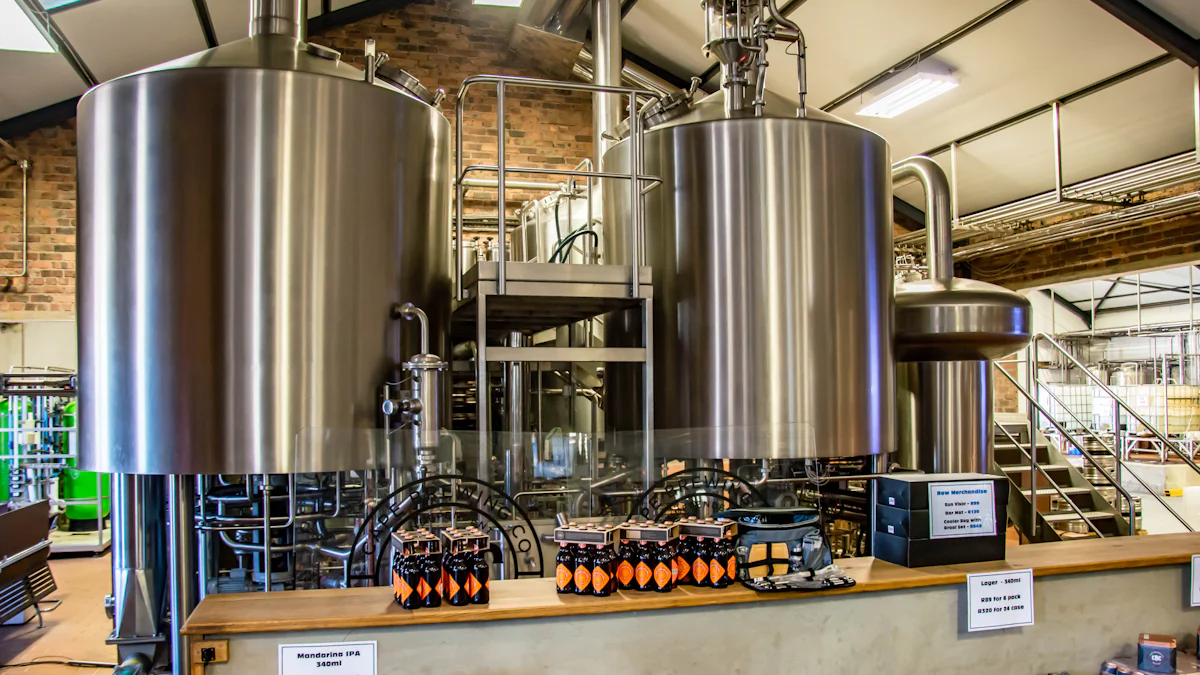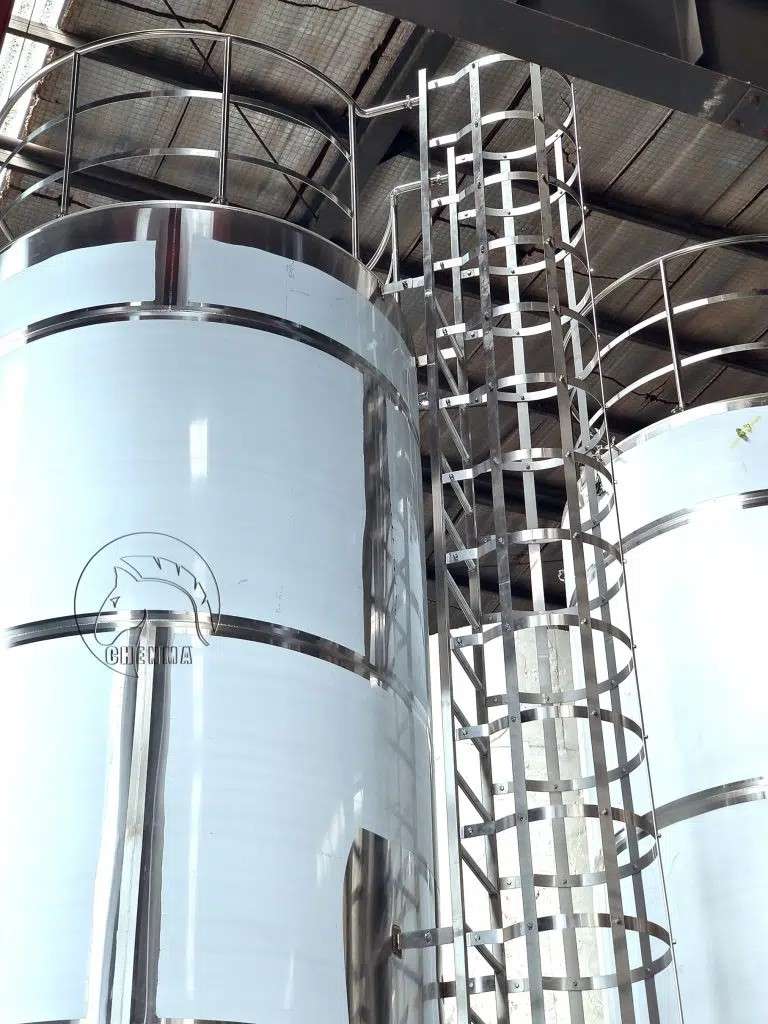
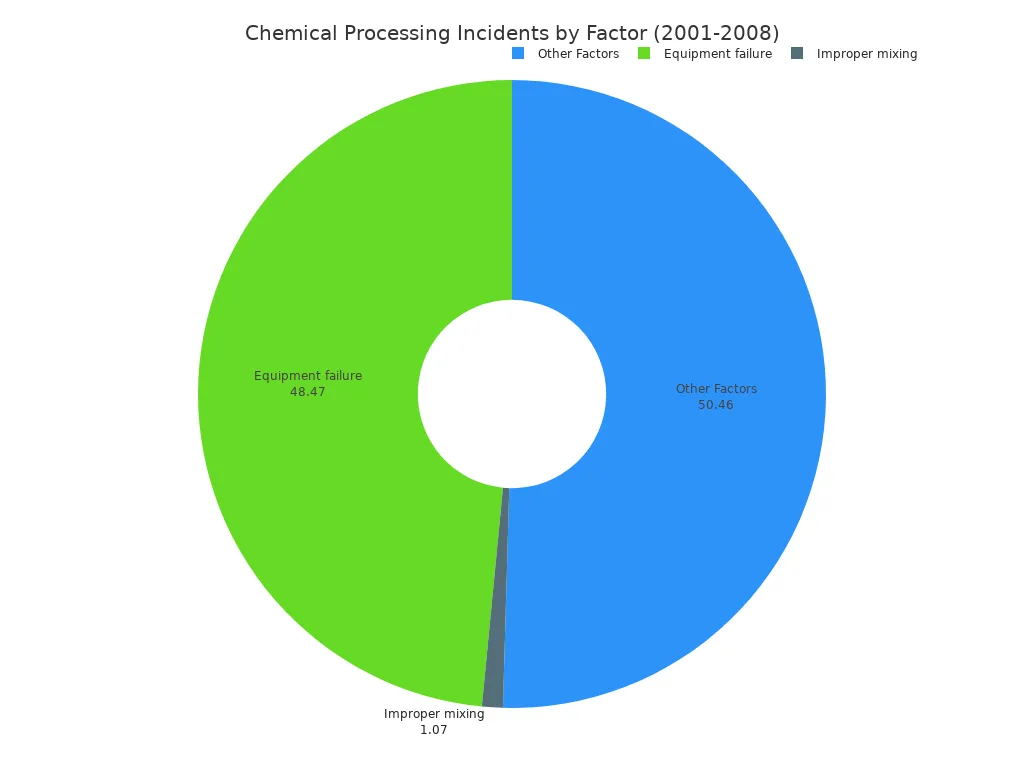
The global chemical equipment market is projected to reach a size of $279.53 billion by 2025. This growth increases the focus on operational safety. Equipment failures remain a significant factor in processing incidents, highlighting risks in daily operations.
You can maximize efficiency with new chemical tank mixing technology. Effective tank mixing improves your process control, reduces costs, and ensures greater safety.
Key Takeaways
- New mixing technologies improve product quality, save money, and increase safety in chemical processing.
- Smart mixing uses AI and sensors to make operations better and predict problems before they happen.
- Advanced designs like hydrofoil impellers and eductors mix materials well and use less energy.
- Magnetic drive mixers offer high safety and purity because they have no leaks.
- Choose the right mixer by understanding your materials, tank, and the total cost over time.
Overcoming Modern Chemical Mixing Challenges
You face several key hurdles in modern chemical processing. These challenges impact your product quality, operational budget, and workplace safety. Understanding them is the first step toward finding the right solutions.
Ensuring Batch Consistency and Quality
You need every batch to be identical. However, achieving consistent quality can be difficult. Several factors often cause batch-to-batch differences:
- Mechanical Issues: Your equipment’s rotation speed may vary, or worn-out parts can reduce mixing efficiency.
- Operational Errors: Operators might use inconsistent mixing times or add materials in the wrong order.
- Material Differences: The moisture or particle size of your raw ingredients can change between batches.
When proper mixing fails, the consequences are significant. Non-uniform batches directly lead to product rejection and financial loss.
| Issue | How It Appears | Business Impact |
|---|---|---|
| Uneven Ingredient Distribution | Product tests show some doses have too little active ingredient, while others have too much. | Batches fail quality control, costing thousands to millions per rejected lot. |
| Ingredient Degradation | High shear or excessive mixing damages sensitive ingredients, reducing product efficacy. | Product performance is compromised, leading to costly reformulation efforts. |
| Formula Instability | Emulsions or suspensions separate over time, creating a layered and unusable product. | Shelf life is reduced, forcing product returns and damaging your brand’s reputation. |
Managing Rising Energy and Operational Costs
Energy consumption is a major operational expense. Inefficient mixers run longer and use more power to achieve the desired blend. This directly increases your utility bills and shrinks your profit margins. Older or poorly designed systems are often the biggest culprits, wasting energy without improving your final product.
Adhering to Strict Safety and Environmental Regulations
Safety is non-negotiable in chemical handling. Your tank mixing process must prevent dangerous reactions and protect your team. Government bodies like OSHA enforce strict rules, such as the Process Safety Management standard (1910.119). This regulation aims to prevent catastrophic releases of hazardous chemicals. A key part of compliance is understanding chemical incompatibility. You must properly tank mix ingredients to avoid a dangerous incompatibility, which can cause toxic fumes, fires, or explosions.
Processing High-Viscosity and Sensitive Materials
You often work with materials that are difficult to mix. Thick substances like polymers, resins, and gels present unique challenges. Traditional impellers struggle with these high-viscosity fluids. The fluid’s resistance causes the flow to become smooth and layered (laminar) instead of turbulent. This change creates several problems for your process.
- Poor Agitation: Your standard impellers cannot generate enough pumping power in thick liquids. This leads to stagnant zones in the tank where ingredients remain unmixed.
- Localized Heat: The impeller creates intense friction in one small area. This heat can damage your product and shows an incompatibility between the mixer and the material.
- Inefficient Mixing: High-speed motors with small impellers are ineffective. They waste energy by spinning in place without moving the surrounding fluid.
Sensitive materials, such as biologics or emulsions, require a different kind of care. These materials can be damaged by too much force, or shear. While some shear is necessary to create a stable emulsion, excessive force can ruin the batch. This process incompatibility can cause droplets to merge or permanently alter the product’s texture. Finding the right balance is critical. Over-processing can destroy the product’s structure and reduce its final efficacy. You need precise control to achieve a stable, high-quality product without causing irreversible damage.
Key Innovations in Chemical Tank Mixing Technology for 2025
New technologies are transforming how you mix chemicals. These innovations help you improve product quality, save money, and increase safety. By understanding these advancements, you can find the perfect solution for your operational needs.
Smart Mixing with IIoT and AI Integration
Smart mixing connects your equipment to intelligent software. Industrial Internet of Things (IIoT) sensors on your tanks collect data in real time. Artificial Intelligence (AI) then analyzes this information to optimize your entire process. This modern chemical tank mixing technology gives you unprecedented control.
IIoT sensors act as the eyes and ears of your operation. They monitor many factors inside and around your tanks.
- Vibration and Temperature Sensors: These track the mechanical health of your mixer, warning you of potential failures before they happen.
- Level and Power Consumption Sensors: You can monitor fluid levels and measure the exact energy used for each batch.
- Air Quality and Pressure Sensors: These ensure a safe operating environment and consistent process conditions.
AI uses this data to make your system predictive, not just reactive. It learns your process and identifies patterns you might miss. For example, a processed food manufacturer used an AI system to monitor its mixers. The AI detected increased energy use, signaling equipment wear before a breakdown occurred. This proactive approach led to a 30% reduction in maintenance costs and a 25% improvement in equipment effectiveness.
Note: AI-powered predictive maintenance allows you to schedule repairs before costly work stoppages. It can increase your equipment uptime by 10 to 20% and reduce maintenance planning time by 20 to 50%.
Advanced Hydrofoil and Eductor Designs
Innovation is not just about software. The physical design of mixer components has also evolved significantly. Advanced hydrofoil impellers and eductors offer powerful performance with greater efficiency.
Hydrofoil impellers are designed like airplane wings. Their curved shape generates strong fluid flow with less power. Unlike traditional flat blades that push liquid, hydrofoils create lift. This smooth, efficient movement reduces shear stress on sensitive materials and lowers your energy bills. Some designs use a central spiral element to create a gentle vortex, achieving a power number as low as 0.36. Other modifications, like U-shaped blades or adding rods to turbines, also help reduce power consumption.
Eductors offer a unique approach to tank mixing. An eductor is a specially designed nozzle that uses a small, high-velocity stream of liquid to move a large volume of surrounding fluid. The key advantage is simple:
This eliminates wear, breakage, and the risk of a component falling into your batch. Eductors are excellent for applications like:
- Blending oils
- General liquid agitation
- Keeping solids suspended in a solution
They are inexpensive and require very little maintenance, making them a cost-effective choice, especially when you need corrosion-resistant materials.
Magnetic Drive Mixers for Enhanced Safety
For applications demanding the highest purity and containment, magnetic drive mixers provide an unmatched level of safety. This chemical tank mixing technology eliminates the most common point of failure in traditional mixers: the mechanical seal.
A magnetic drive mixer has no direct physical connection into the tank. Instead, it uses a powerful magnetic coupling to transmit torque through the tank wall. One set of magnets on the external drive motor turns another set of magnets attached to the internal impeller. This seal-less design offers critical benefits:
- Zero Leakage: With no seal to wear out or fail, you completely prevent hazardous or high-value materials from escaping.
- No Contamination: The hermetically sealed environment stops outside contaminants from entering your product, guaranteeing sterility.
- Reduced Maintenance: You eliminate the costs and downtime associated with replacing mechanical seals.
This design “keeps what’s inside in and what’s outside out,” ensuring total product integrity. However, you must consider operational limits. High temperatures can reduce magnet strength, though special materials like Samarium Cobalt magnets perform well in hotter conditions.
| Parameter | Typical Limitation |
|---|---|
| Working Pressure | -1 to 7 bar(g) |
| Max Media Temperature | 90°C (non-boiling) |
| Max SIP Temperature (0 RPM) | 150°C |
These mixers are the ideal solution when product purity and operator safety are your top priorities.
Ultrasonic and Resonance Mixing Solutions
You can now mix materials without any internal moving parts. Ultrasonic and resonance mixing are advanced forms of chemical tank mixing technology that use energy waves instead of blades. These methods offer unique advantages for sensitive, sterile, or difficult-to-mix applications.
Ultrasonic Mixing: Power Through Sound 🔬
Ultrasonic homogenizers let you create stable emulsions and suspensions using high-frequency sound. This technology is especially useful when you need to break down immiscible liquids, like oil and water, into fine droplets for products in the food and beverage industries.
The process works through a series of precise steps:
- An ultrasonic generator creates powerful sound waves.
- You direct these waves to a titanium or stainless-steel probe submerged in your liquid.
- The probe vibrates at a very high frequency, typically between 20 kHz and 20 MHz.
- These vibrations form microscopic bubbles within the liquid.
- The bubbles rapidly expand and then collapse, releasing intense energy.
This powerful collapse is a phenomenon known as cavitation. It generates localized heat and pressure that breaks down particles and cells, effectively homogenizing your entire batch.
Resonance Mixing: Vibration for Uniformity
Resonance Acoustic Mixing (RAM) is another non-invasive technique that uses low-frequency, high-intensity acoustic energy to create uniform motion throughout your entire vessel. Before 2015, very little research on RAM existed for pharmaceutical applications, highlighting how new this innovation is. It works by vibrating the entire container, which fluidizes the contents and ensures a consistent blend.
This method offers several key benefits for your process:
- Strong Mixing Uniformity: It induces rapid motion and homogenization without creating “dead zones” where material can settle.
- High Safety Factor: You have fewer issues with high temperatures or pressure compared to ultrasonic methods.
- Excellent Performance: The fill level of your tank does not significantly impact mixing performance, and you can mix materials in as little as 30 seconds.
- Easy Scalability: The technology is easy to adapt for industrial-scale amplification.
While promising, you should also be aware of its current challenges. The technology is still maturing, which means it can have high initial costs and some of the underlying mechanisms are not yet fully understood.
A Framework for Selecting Your Mixing Solution
Choosing the right chemical mixing system requires more than just picking the latest model. A structured approach helps you connect your specific process needs with the right technology. This simple framework guides you through the selection process, ensuring you invest in a solution that delivers efficiency, safety, and a strong return.
Step 1: Define Your Process Parameters
Before you can choose a mixer, you must first understand your process inside and out. A successful tank mixing setup begins with a clear definition of your operational variables. Start by documenting the physical and chemical properties of your materials.
Consider the properties of your liquid:
- Viscosity: How thick is your fluid? High-viscosity materials require different mixing energy than thin liquids.
- Density: Do you need to blend liquids of different weights or keep solids suspended?
- Shear Sensitivity: Will high-speed mixing damage your product’s structure?
- Abrasiveness: Will your materials wear down mixer components over time?
Next, evaluate your tank’s physical characteristics. The geometry of your vessel plays a huge role in mixing performance. For example, your tank’s volume directly influences mixer selection. Larger tanks need more powerful mixers to create enough mixing energy, while smaller tanks can use less powerful equipment.
Adding baffles—vertical plates installed on the tank wall—is another critical consideration. Baffles significantly improve mixing efficiency.
- They prevent a central vortex from forming, forcing liquid back toward the impeller.
- They create uniform flow patterns for consistent product quality.
- They enhance surface turbulence, which improves heat transfer and prevents hot or cold spots.
- They reduce swirl and eliminate dead zones where material can settle.
- They minimize wear on mixer parts by reducing stress.
Step 2: Match Innovation to Application Need
Once you define your parameters, you can match them to the right technology. The goal is to find an innovation that solves your specific challenge, whether it’s achieving a stable emulsion, ensuring sterility, or gently blending sensitive ingredients.
A primary consideration is the level of shear your process requires. Shear is the force that one layer of fluid exerts on an adjacent layer. Some applications need high shear to break down particles, while others require gentle, low-shear blending. You must select the right impeller or technology to properly tank mix your ingredients without causing damage.
| Application Type | Mixing Innovation | Characteristics & Purpose |
|---|---|---|
| High-Shear | Rotor-Stator Mixers | Use a fast-spinning blade inside a stationary housing to create intense shear, perfect for emulsification and particle size reduction. |
| Dispersion Blades | Break apart particles through direct impact and intense turbulence, ideal for dissolving solids into liquids. | |
| Low-Shear | Hydrofoil Impellers | Provide gentle agitation with minimal shear, efficiently converting energy into flow for materials that are easily damaged. |
| Gate-Anchor Mixers | Employ large, slow-moving blades to blend high-viscosity materials like gels and creams without introducing excess heat. |
For highly specialized needs, you can match a specific technology to a critical outcome.
For instance, if your goal is to produce stable nano-emulsions, powerful ultrasonic equipment is essential. This technology uses high-frequency sound waves to create intense cavitation, a phenomenon that generates localized energy to break down droplets to the nano-scale. Achieving this requires precise control over all process parameters and specialized accessories like flow cell reactors to ensure a uniform and stable final product.
Similarly, if your top priority is preventing contamination and ensuring absolute containment, a magnetic drive mixer is the clear choice. Its seal-less design eliminates leakage paths, making it ideal for sterile or hazardous applications.
Step 3: Evaluate Total Cost of Ownership
The initial purchase price of a mixer is only one part of the story. To make a truly smart investment, you must evaluate the Total Cost of Ownership (TCO). TCO gives you a complete picture of what a mixer will cost over its entire lifespan.
Key factors to include in your TCO calculation are:
- Operation: This covers the cost of installation, employee training, and the energy the mixer consumes during daily use.
- Maintenance: This includes expenses for routine upkeep like cleaning and lubrication, as well as the cost of unexpected repairs.
- Downtime: This is a major hidden cost. It includes lost production, wages for idle employees, and the potential loss of customers due to missed deadlines.
- Production: This considers how different mixers affect output levels and the final quality of your product.
- Remaining Value: This is the estimated worth of the mixer after a set period, which you can subtract from the total cost.
Energy efficiency offers one of the biggest opportunities for long-term savings. You can project these savings with a clear, data-driven approach.
Tip: Quantify your potential energy savings to justify your investment. A measurement and verification plan can give you the hard data you need.
For example, one facility projected its savings by following these steps:
- Establish a Baseline: They measured the power draw of their old equipment over four weeks to determine a starting point.
- Measure New Equipment: They ran the new mixers for four weeks and measured their power consumption under the same conditions.
- Analyze and Compare: They used a spreadsheet to analyze the data and calculate the difference in energy use between the old and new systems.
- Normalize the Data: They adjusted the metered data to reflect annual operating conditions.
- Quantify Savings: This process revealed a massive annual reduction in energy use, proving the financial benefit of the upgrade.
By focusing on TCO instead of just the initial price, you ensure your new mixer delivers a better long-term return on investment.
Step 4: Plan for Scalability and Integration
Your new mixing technology must work today and prepare you for tomorrow. You need a plan for scalability and integration. Scalability means your process can grow from a small pilot batch to full production volume. Integration means your new equipment can communicate seamlessly with your existing plant control systems. Careful planning in this step protects your investment and prevents future headaches.
Integrating Your Mixer with Plant Controls ⚙️
Your new mixer is not a standalone island. It must connect to your facility’s central brain, often a SCADA (Supervisory Control and Data Acquisition) system. This connection allows you to monitor performance, receive alerts, and control operations from a central hub.
Successful integration starts with early and clear communication. You, your system integrator, and the equipment supplier must work together from the very beginning.
To ensure a smooth connection, you need to define several key details with your equipment supplier:
- System Goals: Clearly state the project’s scope and what you need to monitor. This helps determine the right hardware, software, and network setup.
- Control Philosophy: Get a written description of how the equipment operates. The supplier must understand how you will use the mixer within your plant.
- Data and Alarms: Decide what information you need. Develop a list of data tags for communication and define how alarms will be displayed, acknowledged, and reset.
- Communication Protocols: Discuss how the devices will talk to each other. You should provide the supplier with IP addresses and notify them of your preferred “heartbeat” signals that confirm the system is online.
- Security Measures: Protect your data and equipment from cyber-attacks. You must implement firewalls, data encryption, and user authentication, especially for systems you can access remotely.
Planning for Production Scale-Up 📈
A process that works perfectly in a small lab beaker can fail in a large production tank. Evaluating scalability helps you predict and solve these problems before they cost you time and money. When you increase batch size, you can face new challenges.
- Heat Transfer Issues: A larger volume does not gain a proportional amount of surface area for cooling. For example, a 1,000-fold increase in volume might only give you a 100-fold increase in heat transfer area. This can lead to dangerous hotspots in heat-producing reactions.
- Inconsistent Quality: Reaction rates and mixing efficiency can change at a larger scale. This creates risks for batch-to-batch consistency.
- Hidden Flaws: Some process flaws are not obvious at a small scale. They only become major problems at higher production volumes.
- Equipment Mismatches: Lab-scale equipment often cannot handle the pressures and flow rates of full production. You may need to transition from materials like glass to more durable options like stainless steel.
To scale up successfully, you must understand the core mechanics of your mixing process. A key metric you can use is the impeller Reynolds number (Rei). This number helps you diagnose whether your mixing flow is smooth and layered (laminar) or chaotic and turbulent. Knowing your Rei value is critical for predicting how your mixing time and efficiency will change as you move to a larger vessel.
You can manage these risks by conducting tests in a pilot-scale unit that is large enough to provide useful data. For a final production tank of 10,000 liters, a pilot unit of 500 to 1,000 liters is often a good choice. Partnering with experienced process engineers and equipment vendors like SDCHENMA can also provide critical expertise. Their talented engineers adapt tanks for unique situations daily, helping you design custom stainless steel solutions that ensure your process scales efficiently and safely.
Spotlight on Leading 2025 Mixing Solutions
Now, let’s look at specific technologies that solve key challenges in chemical processing. These leading solutions for 2025 target your needs for efficiency, purity, and gentle handling.
AI-Driven Systems for Large-Scale Blending
You can use AI to make your large-scale blending operations smarter and more profitable. For example, one advanced system uses Artificial Neural Networks to optimize fuel blending. It models complex relationships between ingredients and achieves an impressive accuracy (R2 value of 0.99). This data-driven approach helps you:
- Save significant costs by reducing off-specification products.
- Make better, faster decisions with real-time information.
- Manage complex interactions between different blend components.
- Adapt to changing conditions better than with older methods.
High-Purity Solutions: SDCHENMA Mag-Drive Mixers
When you need absolute purity and safety, magnetic drive mixers are the top choice. SDCHENMA mag-drive mixers provide a completely sealed environment for your product.
The magnetic coupling creates 100% containment. This design keeps your product pure and prevents any hazardous leaks.
Their bottom-mount design allows for excellent tank mixing down to the last drop, increasing your yield. Robust Zirconium Oxide bearings prevent particle shedding, which avoids a critical material incompatibility. The simple design also allows for easy and reliable cleaning procedures like CIP and SIP.
Non-Invasive Tech for Sensitive Materials
Sensitive materials like biologics require extremely gentle handling. A mechanical incompatibility with traditional high-shear mixers can easily damage or destroy your valuable product. Non-invasive technologies solve this problem by mixing without internal parts.
- Wave Mixer System: This technology uses a gentle, non-invasive rocking motion in disposable bags. It minimizes shear forces and prevents product damage.
- Recirculation Line: This method uses a pump to circulate fluid through tubing, keeping materials mixed without an impeller.
You can use tools like Computational Fluid Dynamics (CFD) to simulate these gentle mixing profiles. This helps you validate the design and ensure it is perfect for your shear-sensitive materials.
You can find the best solution for your operations in 2025. The right chemical tank mixing technology matches your specific process needs with targeted innovations.
- You can future-proof your tank mixing operations with AI-driven controls and advanced impeller designs.
- Use the framework in this guide to evaluate your current systems and talk to technology providers.
- You properly tank mix materials and achieve a better long-term return when you prioritize total cost of ownership over the initial price.
FAQ
How do I choose the right mixer for my chemical tank?
You should first define your process needs. Consider your fluid’s viscosity and your tank’s size. Then, you can match these needs to a specific technology. For example, you might select a hydrofoil impeller for gentle blending or a magnetic drive mixer for high-purity applications.
What makes magnetic drive mixers safer?
Magnetic drive mixers use magnets to turn the impeller through the tank wall. They have no direct seal into the tank. This seal-less design prevents leaks and stops outside contaminants from entering your product. It provides you with total containment and superior safety.
How can I reduce energy costs with my mixer?
You can lower energy use by choosing efficient equipment. Advanced hydrofoil impellers move fluid with less power than traditional blades. Additionally, smart systems with IIoT sensors help you monitor energy consumption and optimize mixing times for each batch, preventing waste.
Why is my mixer creating too much heat?
Excess heat often signals a process incompatibility. Your mixer might be too powerful for the fluid’s viscosity, creating intense friction that can damage your product. You may need a different impeller design or a lower-shear technology to improve efficiency and protect your batch.