
For dairy processing plants, food safety, cleanability and consistent product quality are non-negotiable. That is why stainless steel is the global standard for nearly all dairy production and storage equipment: it combines corrosion resistance, mechanical durability and smooth, sanitizable product-contact surfaces that no other common material can match.
Food-grade grades like 304 and 316L are used for everything from milk silos and pasteurizers to process vessels and sanitary piping. The value goes far beyond raw material strength: properly engineered stainless steel equipment supports reliable sanitation, withstands repeated chemical cleaning and thermal cycles, and delivers decades of dependable service.
Key Takeaways
- Stainless steel delivers smooth, non-porous, easy-to-clean contact surfaces that minimize bacterial growth risk in dairy production.
- 304 is the standard grade for general dairy use; 316L is preferred for more corrosive environments and high-chloride cleaning processes.
- Hygienic design — including surface finish, weld quality, drainage and CIP compatibility — is just as important as the material itself.
- Stainless steel resists corrosion from dairy products and cleaning chemicals, and maintains structural stability through repeated heating and cooling cycles.
- While upfront costs are higher, stainless steel delivers lower total cost of ownership thanks to longer service life, less maintenance and reduced downtime.
Unmatched Hygienic Performance for Dairy Safety

Dairy products are highly perishable and sensitive to bacterial contamination. Equipment must be designed to eliminate residue buildup and support consistent, repeatable cleaning. Stainless steel is the ideal foundation for hygienic dairy processing.
Non-Porous, Precision-Polished Contact Surfaces
Properly finished stainless steel surfaces are smooth, non-absorbent and free of pores or crevices where milk fat, protein and bacteria could accumulate.
- Standard sanitary finishes use grinding and polishing to reach a surface roughness of 32 microinches (0.8 μm) Ra or smoother, per 3-A guidelines.
- Advanced processes like passivation and electropolishing further enhance corrosion resistance and create an even more uniform, cleanable surface.
Surface finish is only one part of hygienic design. Full cleanability also depends on continuous sanitary welds, fully drainable geometry, easy access for inspection, and dead-leg-free piping — all design practices that pair naturally with stainless steel fabrication.
Compliance With Global Sanitary Regulations
Nearly all major dairy regulatory frameworks mandate stainless steel or equivalent corrosion-resistant, cleanable materials for product-contact surfaces.
- In the U.S., state and federal dairy regulations require tanks, pasteurizers, coolers, pumps and sanitary piping to be built from stainless steel or materials with equal corrosion resistance and cleanability.
- 3-A Sanitary Standards set industry-leading requirements for material, fabrication, surface finish, drainage and cleanability, and are widely accepted as the benchmark for dairy equipment design.
When purchasing equipment, always verify applicable certifications and documentation rather than assuming all “stainless steel” products meet the same sanitary standards.
Built for Efficient CIP Cleaning
Modern dairy facilities rely on Clean-in-Place (CIP) systems to clean equipment between production runs without full disassembly. Stainless steel is inherently well suited for CIP when paired with proper equipment design.
- Integrated spray balls and distribution systems deliver cleaning chemicals evenly across product-contact surfaces.
- Smooth walls, sanitary welds and self-draining geometry ensure cleaning solution reaches all areas and drains completely, with no trapped residue.
- Stainless steel resists degradation from standard dairy cleaning chemicals (caustic, acid, sanitizers) when used at correct concentrations and temperatures.
Superior Durability in Harsh Dairy Environments
Dairy equipment operates under constant stress: exposure to milk solids, aggressive cleaning chemicals, mechanical loads and repeated heating and cooling cycles. Stainless steel delivers the corrosion resistance and structural stability to perform reliably for decades.
Corrosion Resistance
Stainless steel forms a self-healing chromium-rich passive layer on its surface that protects against corrosion from moisture, dairy products and repeated cleaning cycles.
- 304 stainless steel: The industry standard for most general dairy applications, including storage tanks, piping and standard process equipment.
- 316L stainless steel: The low-carbon, higher-alloy upgrade for more aggressive environments. Choose 316L for facilities using chlorinated cleaning chemicals, high-salt products, or operating in coastal high-humidity locations.
Fabrication quality matters as much as the base grade. Poor welds, surface contamination and crevices can create localized corrosion even on high-grade stainless steel.
Thermal Stability for Pasteurization & Thermal Processes
Pasteurization, fermentation and other dairy processes involve repeated heating and cooling cycles. Stainless steel maintains excellent dimensional stability and mechanical strength across wide temperature ranges, making it ideal for jacketed tanks, heat exchangers and pasteurization vessels.
Good tank design also accounts for thermal expansion, operating pressure and insulation. Matching the correct stainless steel grade to the process temperature and pressure ensures reliable performance over thousands of production cycles.
Lower Total Cost of Ownership Over Time
Stainless steel equipment has a higher upfront purchase price than alternatives like carbon steel or plastic, but it almost always delivers better value over the full equipment lifecycle.
Reduced Maintenance & Replacement Costs
Corrosion-resistant stainless steel avoids the rust, degradation and pitting that plague ordinary steel equipment. This means fewer repairs, fewer material failures and much longer service life — 15–30 years is typical for well-maintained stainless steel dairy tanks.
Preventive maintenance is still required for wear parts like gaskets, valves, pumps and agitators, but the tank body itself will remain serviceable for decades.
Less Unplanned Downtime
Reliable equipment means fewer unexpected production stops. A well-designed stainless steel tank with proper insulation, temperature control and CIP capability runs consistently cycle after cycle, with minimal unplanned maintenance.
For dairy facilities, even a few hours of downtime can result in thousands of dollars in lost product and production. The reliability of stainless steel directly reduces this risk.
Stainless Steel vs. Alternative Materials
| Material | Upfront Cost | Hygiene | Durability | Lifespan | Best For |
|---|---|---|---|---|---|
| Stainless Steel (304/316L) | High | Excellent: smooth, non-porous, CIP-compatible | Excellent: corrosion & heat resistant | 15–30+ years | All product-contact dairy equipment |
| Enameled Carbon Steel | Medium | Good when intact; chips harbor bacteria | Poor: chips & cracks easily | 5–10 years | Bulk non-food storage only |
| Food-Grade Plastic | Low | Fair: softer surface scratches easily | Poor: limited temperature resistance | 3–7 years | Small accessories, not process vessels |
| Galvanized Steel | Very low | Poor: porous, not cleanable | Poor: corrodes rapidly | 2–5 years | Non-contact structural parts only |
Common Applications of Stainless Steel Dairy Equipment

Stainless steel is used at every stage of dairy production, from raw milk receiving to finished product packaging.
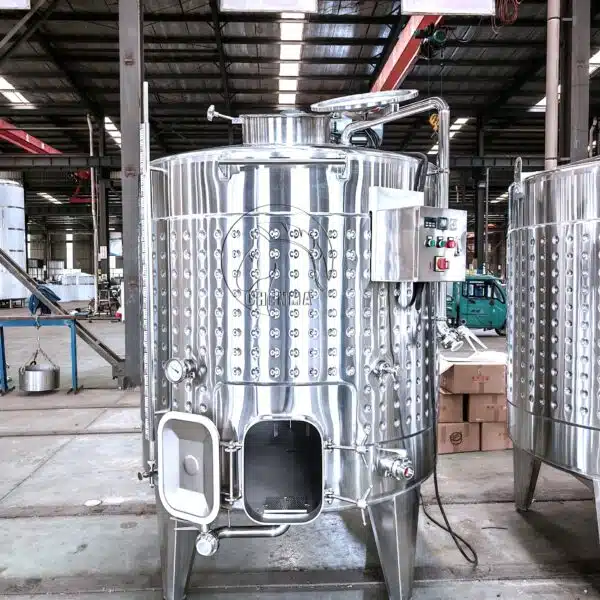
- Milk storage tanks & silos: Insulated, cooled stainless steel vessels maintain consistent low-temperature storage for raw milk, with level sensors and sanitary fittings for daily operation.
- Pasteurization & processing vessels: Jacketed stainless steel tanks with agitation deliver uniform heating and cooling for pasteurization, standardization and other thermal processes.
- Fermentation tanks: Temperature-controlled stainless steel vessels support consistent yogurt, cheese and cultured product production, with sampling ports and full CIP compatibility.
- Sanitary piping, pumps & valves: All product transfer lines use stainless steel tubing with hygienic connections to eliminate dead spots and support full cleanability.
For custom production lines, working with an experienced stainless steel dairy equipment manufacturer like CHENMA ensures tank size, material grade, cooling capacity, agitation, and CIP systems are engineered to match your specific process requirements.
Conclusion
Stainless steel is the standard for dairy processing because it delivers the best combination of hygiene, corrosion resistance, durability and cleanability — all critical for safe, consistent dairy production. The material itself is only part of the equation: hygienic design, high-quality fabrication, proper grade selection and regular maintenance are equally important for long-term performance.
For any product-contact dairy equipment, stainless steel is almost always the most reliable, most compliant and lowest total-cost choice over the full lifecycle of the equipment.
FAQ
Why is stainless steel used for dairy equipment?
Stainless steel combines corrosion resistance, mechanical durability and smooth, non-porous product-contact surfaces that are easy to sanitize. U.S. and global dairy regulations specifically require stainless steel or equivalent materials for all product-contact processing equipment.
What stainless steel grades are used in dairy processing?
304 is the standard workhorse grade for most general dairy applications including storage, piping and basic process equipment. 316L is used for more corrosive environments, chlorinated cleaning systems and high-acid dairy products.
How does surface finish affect dairy equipment hygiene?
A smoother surface is easier to clean and less likely to trap milk residue and bacteria. 3-A sanitary standards require a surface finish of 32 microinches (0.8 μm) Ra or smoother for product-contact surfaces, along with smooth, continuous welds and no crevices.
Can stainless steel equipment be cleaned with CIP systems?
Yes. Stainless steel is the standard material for CIP-compatible dairy equipment, as it resists degradation from standard cleaning chemicals. Effective CIP also depends on spray coverage, flow rate, temperature, chemical concentration and fully drainable equipment design.
How do I choose between 304 and 316L dairy equipment?
Choose 304 for general-purpose storage, standard process tanks and normal cleaning regimens. Upgrade to 316L if you use chlorinated cleaning chemicals, process high-salt or high-acid products, or operate in a coastal high-humidity environment.
Is ISO 9001 certification the same as sanitary certification?
No. ISO 9001 is a general quality management system certification for the factory. It is not equivalent to product-specific sanitary certifications like 3-A or FDA food contact compliance. Always verify product-level sanitary documentation for dairy equipment.