
The price of a milk pasteurizer ranges from several hundred to several thousand dollars. Prices depend on the brand and features. Brands like Kolice, Milky, and CHENMA offer various models. Prices are influenced by several key factors:
- Complying with safety regulations
- Using the machine to improve work efficiency
- Consumer demand for higher quality dairy products
Key Takeaways
- Milk pasteurizers range in price from $300 to $20,000. Choose a machine that suits your needs and budget.
- Consider the machine’s processing capacity. Larger capacity machines can process more milk and save you time. These machines may offer good value for money.
- Choose stainless steel milk tank. Stainless steel is durable, easy to clean, and helps ensure milk safety.
Milk Pasteurization Machine Price Range

Home and Small-Scale Models
Those using milk at home or running a small dairy business can choose a small machine. These machines are easy to operate and portable. Kolice, Milky, and VEVOR are all high-quality pasteurizer brands suitable for beginners and small workshops. These machines typically range in price from $300 to $1200. Prices will vary depending on the machine’s features or capacity.
- Batch pasteurizers heat milk in large containers, suitable for processing small quantities of milk.
- Continuous pasteurizers use heating elements to heat milk, ideal for users looking to increase efficiency.
- Benchtop pasteurizers are compact and portable, making them popular with small cheese workshops.
Most small pasteurizers hold 5 to 500 liters of milk. They ensure milk safety through precise temperature control. Many small machines consume little electricity, thus saving costs. Parts can be easily disassembled for cleaning. Because these machines are portable, farmers can take them to their farms.
Tip: Small dairy plants can use stainless steel milk tanks. These tanks ensure the milk remains safe before and after pasteurization.
Commercial and Medium-Scale Models
Medium-sized dairy and cream mills require more powerful, large machines. These machines can process 500 to 5,000 liters of milk at a time. Prices range from $1,200 to $5,500. Machines from brands like Kolice and Milky are equipped with digital buttons and automatic cleaning systems.
These machines typically feature:
- Special temperature control functions
- Automatic mixing and heating functions
- Easy-to-clean stainless steel components
Medium-sized dairy plants may also use stainless steel milk tanks and yogurt fermentation tanks. For example, a 10,000-liter yogurt fermentation tank keeps milk fresh and readily available.
Note: Maintenance costs for commercial machines are not high. They are easier to maintain compared to large machines.
Industrial-Scale Machines
Large dairy and processing plants require powerful machines. These machines can process thousands of liters of milk at a time. Basic machines start at $300, while high-end machines can cost up to $20,000. Most medium-sized machines range in price from $1,200 to $5,500.
- Simple machines are suitable for simple operations.
- Advanced machines can automate all operations and produce large quantities of milk.
- Some machines are energy-efficient and offer expert guidance.
These machines are being purchased by a growing number of people worldwide. Experts predict the market will reach $2.8 billion by 2028. Large dairy plants use stainless steel milk silos and large fermentation tanks (such as 30,000-liter milk silo tanks) to store large quantities of milk.
| Type of Equipment | Maintenance Cost Comparison |
|---|---|
| Milk Pasteurization Machine | Medium cost to take care of, not as high as very big machines. |
Tip: Choose the right milk pasteurizer based on your needs, budget, and space. Other tools such as milk tanks and silos can help you work better and ensure milk safety.
Features That Affect Milk Pasteurization Machine Price

Capacity and Output
The size of a milk pasteurizer affects its price. Larger capacity machines can process more milk at once, meaning less downtime and increased efficiency. Common capacities are 30 liters, 50 liters, 100 liters, and 1000 liters. Larger capacities are more expensive. Larger machines require more robust components and more sophisticated systems.
| Capacity (L) | Price Impact | Efficiency Impact |
|---|---|---|
| 30 | Moderate | High |
| 50 | Higher | High |
| 100 | Higher | Very High |
| 1000 | Highest | Maximum |
- Larger machines can help dairy farmers save time.
- Higher efficiency can compensate for a higher price.
- Choose the appropriate capacity based on your milk processing volume.
Automation and Controls
Automation makes machines easier to use and more reliable. Machines equipped with digital buttons, automatic stirring, and intelligent temperature settings are more expensive. These features help maintain milk at the proper temperature and make the entire process safer.
Many newer machines are equipped with intelligent control systems. You can set and monitor the entire process. Some machines even have IoT capabilities, allowing them to acquire data in real time. Automation helps avoid operational errors and ensures the milk is safe to drink.
Note: Shandong Chenma Machinery Co., Ltd. manufactures a 300-liter pasteurizer equipped with an automatic stirring function. While this makes the machine more expensive, it is also more convenient to use.
Build Quality and Materials
The materials used in the manufacture of a milk pasteurizer determine its price and lifespan. Most machines use high-quality stainless steel. Stainless steel does not rust or corrode, is easy to clean, is safe for food, and is heat-resistant and washable.
| Feature | Description |
|---|---|
| Material | High-quality stainless steel |
| Durability | Resists rust and corrosion |
| Maintenance | Easy to clean, hygienic surface |
| Performance | Maintains form under heat and cleaning |
| Longevity | Resists wear from daily use |
Companies like Shandong Chenma Machinery Co., Ltd. use stainless steel in their tanks and machines. This makes the equipment robust, durable, and long-lasting.
Extra Functions
Additional features may increase the cost of the machine, but they can also enhance its value. Some machines are equipped with high-efficiency boilers or heat exchangers. These features help reduce energy consumption and are more environmentally friendly. Cleaning systems such as Clean In-Situ (CIP) can save time and reduce water and steam usage.
| Feature | Impact on Pricing |
|---|---|
| High-Efficiency Boilers and Heat Exchangers | Improves thermal efficiency, lowers costs |
| Thermal Energy Storage (TES) | Reduces steam demand, saves money |
| Energy-Efficient Pasteurization | Lowers energy bills |
| Regenerative Pasteurization (HTST Systems) | Recovers heat, reduces energy costs |
| Energy-Efficient CIP Systems | Saves on steam costs |
| Specialty Cleaning Chemicals | Shortens cleaning cycles, reduces costs |
Many machines now focus on energy conservation and environmental protection. Approximately 45% of new machines incorporate energy-saving technologies. This helps dairy companies save costs in the long term.
Tip: Purchasing a machine with good cleaning and energy-saving features can save you money in the future.
Real-World Price Examples
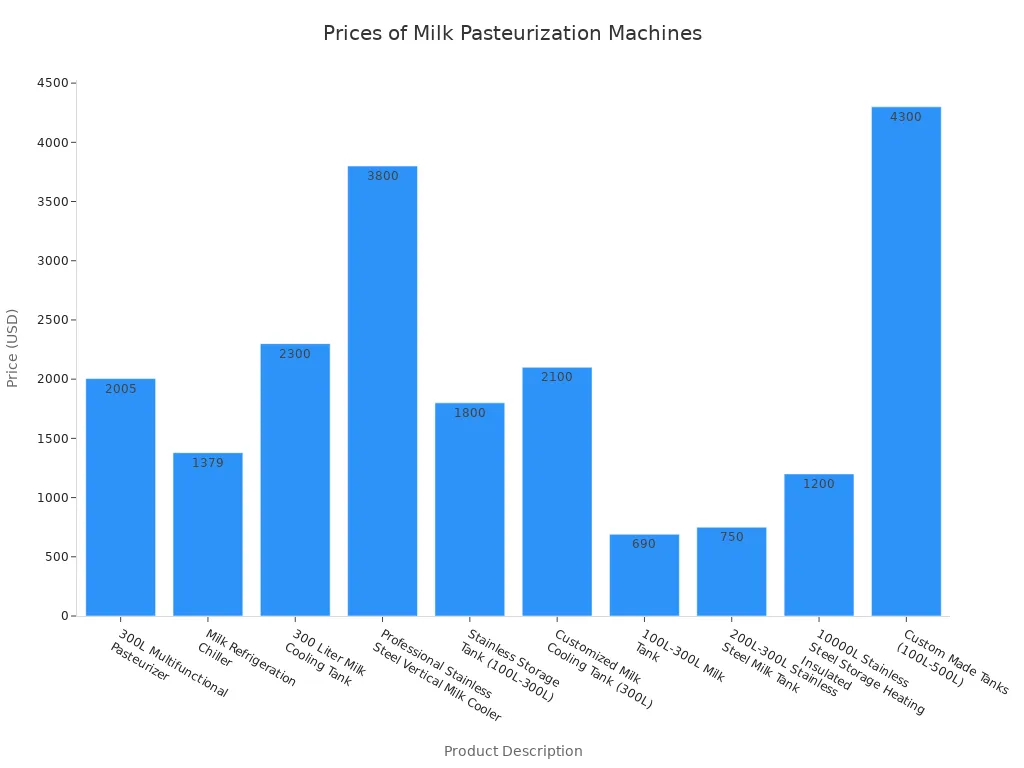
Companies like Shandong Chenma Machinery Co., Ltd. demonstrate how features affect price. For example, a 300-liter stainless steel automatic stirring pasteurizer costs approximately $2,005. A professional-grade stainless steel vertical milk cooler equipped with a dedicated compressor can cost as much as $3,800. Custom-made storage tanks with special functions can cost as much as $4,300.
Note: Picking the right milk pasteurization machine means looking at both features and how much you will save later. Machines with better materials, smart controls, and energy-saving systems may cost more at first but save money over time.
Choosing Your Milk Pasteurization Machine
Assessing Production Needs
Choosing the right milk pasteurizer begins with understanding your business objectives. Owners should determine the products they want to produce and set their milk processing volume. A small dairy plant might process 1,000 gallons of milk per day, while a large dairy plant might process 50,000 gallons per day. Drawing a production flow chart helps identify which stages require specialized equipment. Checking utilities and space is crucial. The machine requires electricity, water, and sufficient workspace. Owners must ensure their plant can accommodate the selected machine.
Tip: Choosing the right size machine can save costs and avoid delays.
Comparing Features and Costs
Buyers should consider technology, safety, and materials when selecting a machine. Automation features, such as digital control and automatic agitation, help improve efficiency. Stainless steel components have a longer lifespan and ensure milk safety. An easy-to-use design makes cleaning and maintenance easier. Owners should consider both price and operating costs. Machines with lower energy consumption and less waste can save on ongoing costs. Good customer support and clear warranty terms are also essential.
| Feature | What to Check |
|---|---|
| Automation | Digital controls, auto-stirring |
| Safety | USDA or EU compliance |
| Materials | Stainless steel, food-grade quality |
| Support | Warranty, training, spare parts |
Value Tips
Expert advice on how to get the best deal. Owners should consider all costs, such as maintenance and energy consumption. Leasing or buying used equipment may have lower initial costs. Machines with good temperature control and insulation ensure milk safety. Seller assistance can reduce risk and help you grow in the future.
- Choose a machine that can adapt to changing needs.
- Be sure to read the warranty details and obtain the serial number.
- Look for grants or installment payment plans to help with payments.
Note: Well-planned and wise choices help dairy businesses grow.
Buyers should choose based on machine size, price, and features. The following table lists key information:
| Scale | Price Range | Key Features to Prioritize |
|---|---|---|
| Small-scale | $1,500–$8,000 | Capacity, manual or semi-automation |
| Medium | $10,000–$30,000 | Automation, higher capacity |
| Large | $50,000–$250,000+ | Advanced technology, build quality |
Communicating with the manufacturer helps buyers obtain special options. Buyers can also obtain assistance with training and maintenance.
FAQ
How much does a milk pasteurizer cost?
Small machines cost around $300. Large industrial machines can cost up to $20,000. Prices will vary depending on the machine’s features or capacity.
What materials do manufacturers use to manufacture milk pasteurizers?
Most machines are made of stainless steel. Stainless steel does not rust and is easy to clean. It helps ensure the safety of drinking milk.
How often should a milk pasteurizer be cleaned?
The machine should be cleaned after each use. This ensures the safety of the milk. Many machines are equipped with automatic cleaning systems, making cleaning even more convenient.